05 Web Portal in General
The web portal can be reached at the following web address: https://[YOUR PORTAL URL].appspot.com/. The web portal is a platform on which various customer-specific processes and assets are integrated. The process and measurement data are displayed and processed in different ways, e.g., as tiles for an overview, cockpit views of live data and individual analyses so that the organization can successfully draw conclusions about the current status and added value.
05.1 Platform Structure
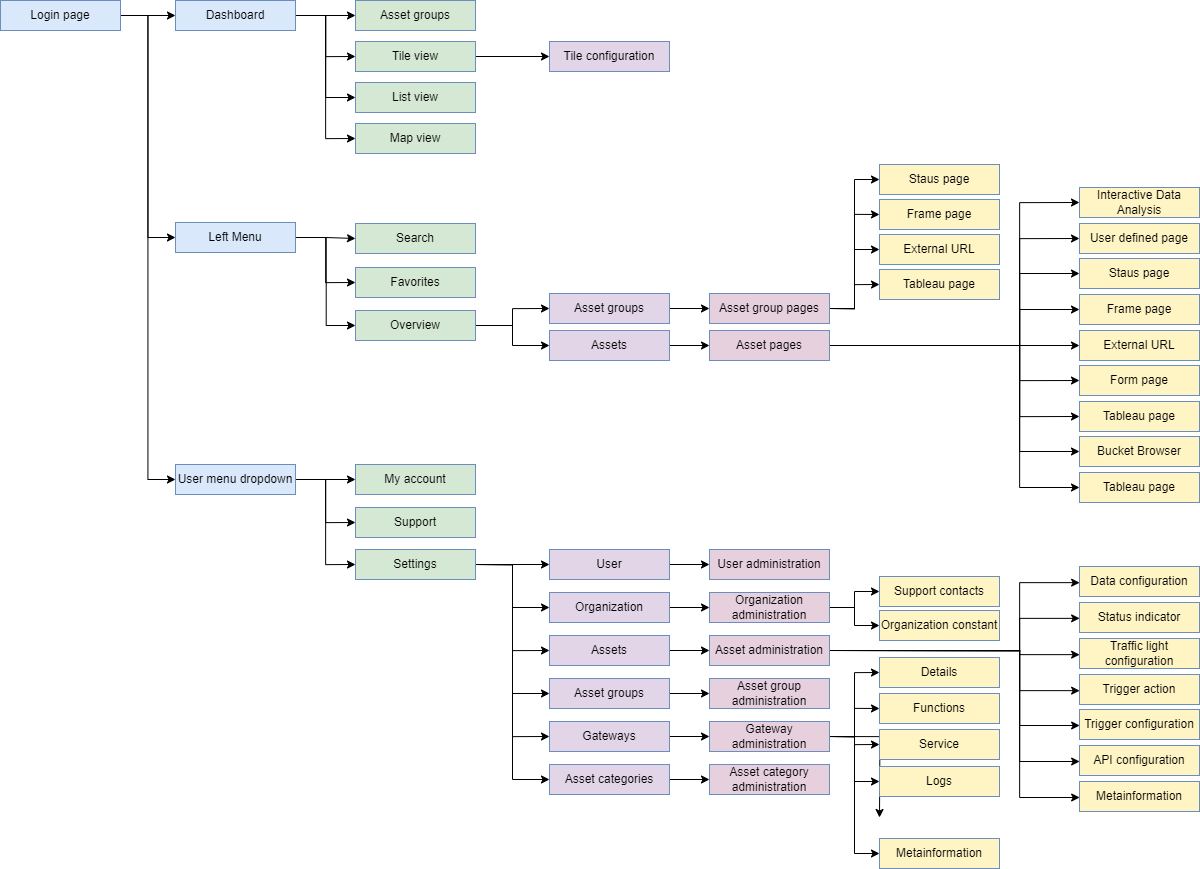
The figure below shows the structure of the portal pages and their link points. The individual pages can be viewed and edited depending on the authorization. In the following, all the different pages and their functioning are explained. The illustration serves for orientation on the platform.
05.2 Login
After the administrator has added a new user, the user receives an e-mail with his personal password. With this password and the e-mail address, it is possible to log in to the portal. The user can also login with Google credentials and click the 'Forgot password' button to receive an email to reset the password. The login window of the scitis portal can be reached via the following link. https://[YOUR PORTAL ADDRESS].appspot.com/
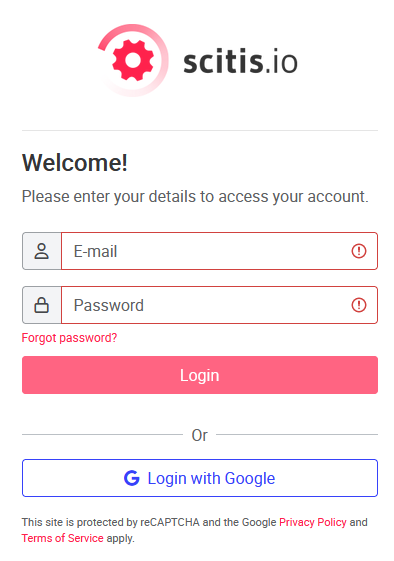
The login page is not available when using Google Single sign-on!
05.3 Header and logout
The logged in user will see the account name in the upper right corner. After clicking on this name a dropdown menu opens. Here there are the areas Settings and Support, which, depending on the user authorization, forward to the corresponding portal settings. The pen button  next to the user's email address takes you to the user's profile settings. The Logout button
  logs out the current user.
The functions in the Settings paragraph are used to manage all functions, users and assets of the portal and is divided into the following pages:
- Users - add, remove, edit, (unlock), change password
- Organizations - add, remove, edit, reset terms of use
- Assets - add, remove, edit, configure data display, list gateways
- Asset groups - add, remove, edit, assign assets
- Gateway - remove, edit, configure, gateway details
- Asset categories - add, remove, edit and configure asset categories
Not all sections are available for every user. Administrative sections are only available to ADMIN and TECH_ADMINs.
Detailed explanations of the individual functions can be found in the 'Management elements' chapter
Via the flag symbol to the right of the logout button, the language can be selected from a choice of English, German, Italian, French, Korean, Polish, Turkish and Chinese.
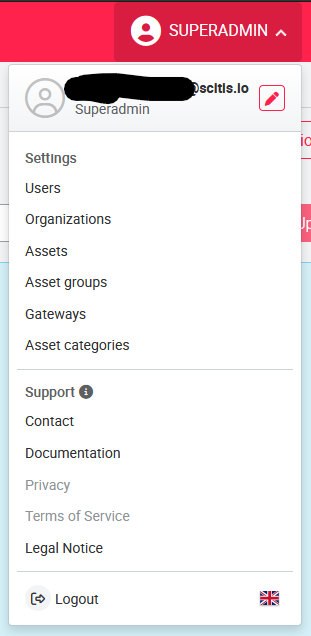
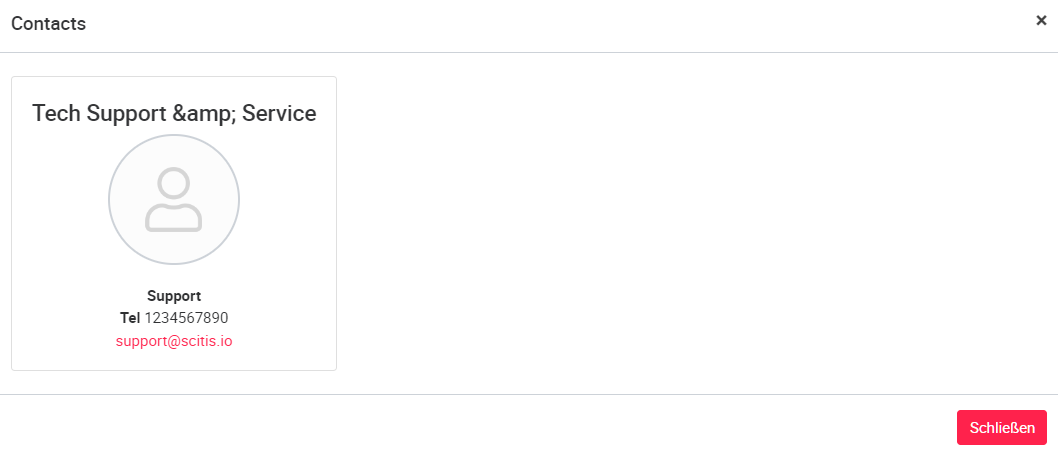
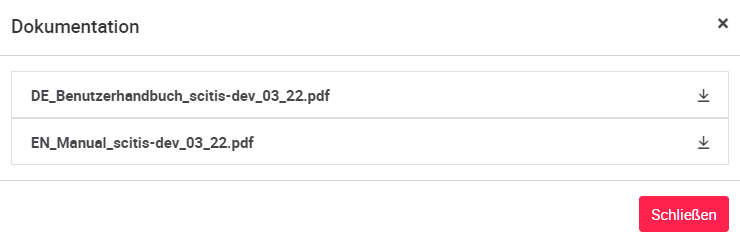
In the Support section you can find contact information for support (contact) and documentation. In addition, you can view the current software version via the information icon  .
.
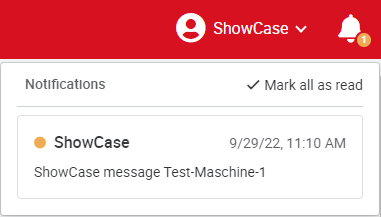
The bell icon leads to the notification center. Alarms and notifications are displayed to the user here.
notifications are displayed to the user. The number of notifications is shown directly via the appearing number above the bell symbol. In the notification center, the user can, for example, inquire about current malfunctions without having to check his e-mails.
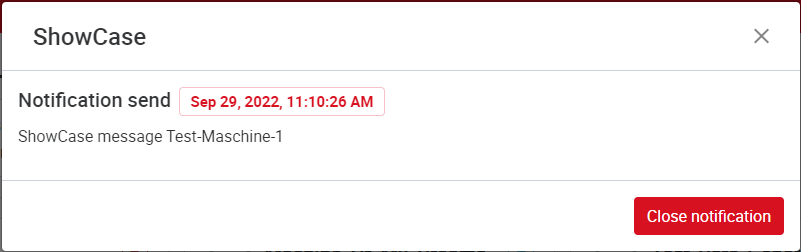
After the user has clicked on the notification, it is automatically marked as read. Alternatively, the checkbox to the right of the message can be used to mark it as read and thus delete it.
How to activate the notifications and alarms can be found in the Trigger action chapter
05.4 My account
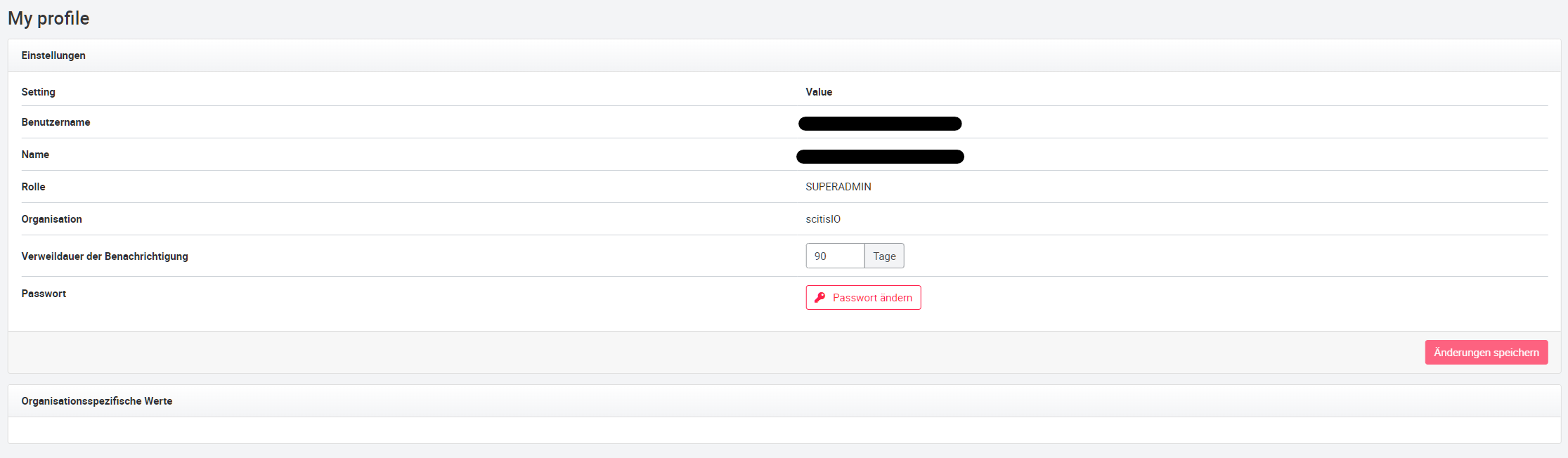
Via Edit profile you will be redirected to the profile page of your account. Here you can change your account password and view the organization specific values. Under Organization Specific Values, a specific value can be created by the admin with a time start and end range. This value can be calculated and output with other values and signals in the portal.
05.5 User Manual Chatbot
The SCITIS Manual Chatbot helps users find information from SCITIS manuals and technical documentation more easily.
Instead of manually searching through long PDF manuals or documentation pages, users can ask the chatbot a question in normal language. The chatbot searches the available documentation and gives an answer based on the related manual content.
The chatbot is designed to support users while working with SCITIS documentation. It is not a general chatbot and should only be used for questions related to SCITIS manuals, portal documentation, devices, configuration, safety instructions, and related technical documents.
Where to Find the Chatbot
The chatbot is available inside the SCITIS portal.
Users can open it from the chatbot icon at the bottom-right corner in the portal.
What You Can Ask and what answers can be expected
The chatbot answers based on the available SCITIS documentation. Users can ask questions related to SCITIS manuals, portal usage, technical documentation, devices, configuration, and safety information.
The chatbot can answer questions in English and German, depending on the question and the available documentation.
Example English questions:
- What is CloudPlug Edge?
- What should I do if there is a flue gas smell?
- How can I create a new user?
- Which safety devices are included in the PYROT boiler?
- How can I configure data collection?
Example German questions:
- Welche Brennstoffe können mit dem PYROT verwendet werden?
- Was soll ich tun, wenn Abgasgeruch auftritt?
- Welche Sicherheitseinrichtungen hat der PYROT Heizkessel?
The chatbot works best when the question is clear and specific.
Example answer:
PYROT is a fully automatic solid fuel boiler with rotary combustion. It is designed for burning dry wood chips and wood pellets.

Source: PYROT_BA_DE_11070881_2023-11.pdf
For some questions, the chatbot may provide a list of steps. For example, if a user asks how to create a new user, the chatbot can explain the steps based on the portal manual.
The chatbot only answers from available SCITIS documentation.
Tips for Better Questions
For better answers, users should ask clear and specific questions.
Good examples:
- What fuels can be used with PYROT?
- What should I do if there is flue gas smell?
- How can I create a new user?
Less helpful examples:
- Explain everything.
- What is this?
- Tell me all the details.
- Help me.
Clear questions help the chatbot find the correct information faster.